Ask
The app you talk to when you need an answer.
Our AI Harness Technology
An AI harness gives an AI model the tools, context and rules it needs to do real work.
You already know the idea
The app you talk to when you need an answer.
The system that reads a pile of documents and turns them into a briefing you can use.
The interface that can produce a website or application from a few instructions.
Those are jobs. A model can help with them. The next section names what has to sit around the model for the job to hold together.
Model vs harness
Provides language, reasoning and generative ability.
Connects that ability to your information, tools, constraints and process so the work can be completed and checked.
What Radi adds
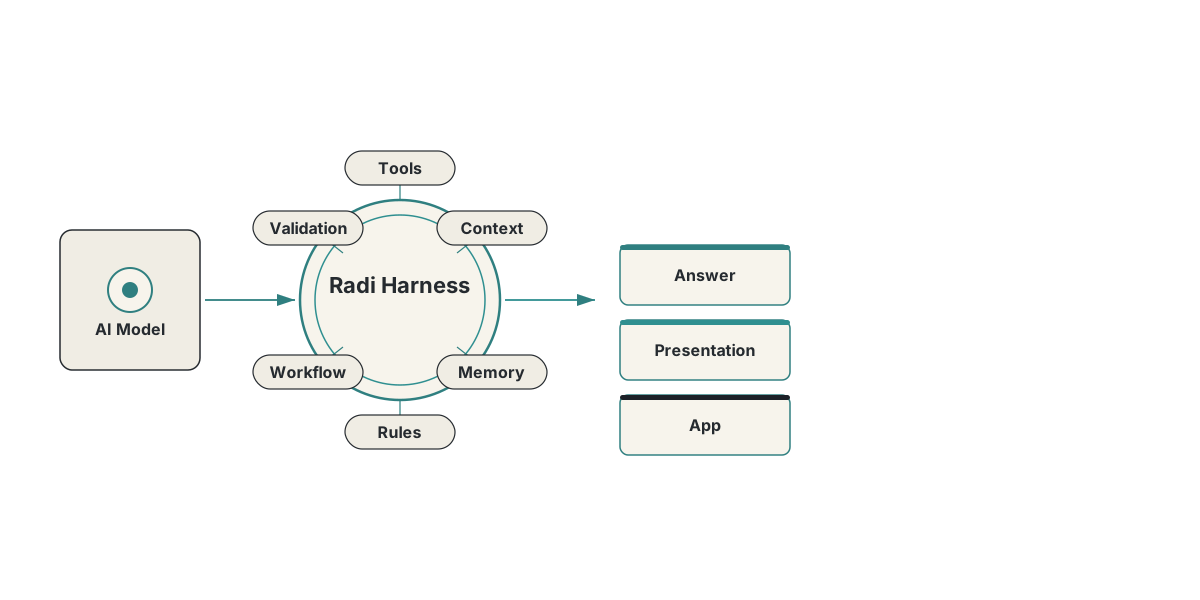
Radi is the surrounding process. Work comes in, the model is used where judgment is needed, and a result leaves only after it has been checked.
The diagram names the parts. The point is how they behave together: they can be designed, tested and improved as a system, not as a one-off prompt.
Operating model
Useful work depends on the environment around the worker: a bounded job, the right context and tools, visible handoffs, and results that can be inspected. Capability is not the same thing as a reliable way of working.
Complex output is more repeatable when it is split into stages with explicit inputs, outputs and inspection points. Intermediate artifacts are kept. Failures are meant to be caught before they quietly become the next stage’s input.
Those principles can be reused for different kinds of work — identity and positioning, operations, software production, opportunity research — without turning those jobs into one interchangeable product. Each domain still has its own knowledge, tools and acceptance criteria.
Much of the durable value sits in the process, the artifacts, the accumulated knowledge and the checks, not in whichever model or worker happens to be in use. A worker can be replaced without throwing the factory away, as long as the operating contract can still be met. That is a goal, not a claim that replacement is free: prompts, tools, context formats and adapters often have to change.
Workers are probabilistic. Important boundaries should be explicit: validation, independent review, human approval, or checks after an action, depending on the job. Judgment is not removed. It is placed on purpose instead of being left inside one opaque run.
Why it matters
The AI works with the information and constraints that belong to the task, not only what fits in a prompt.
The same process and checks can run again instead of starting from a blank chat every time.
When a better model or worker appears, the surrounding process, artifacts and knowledge are still there to use.